

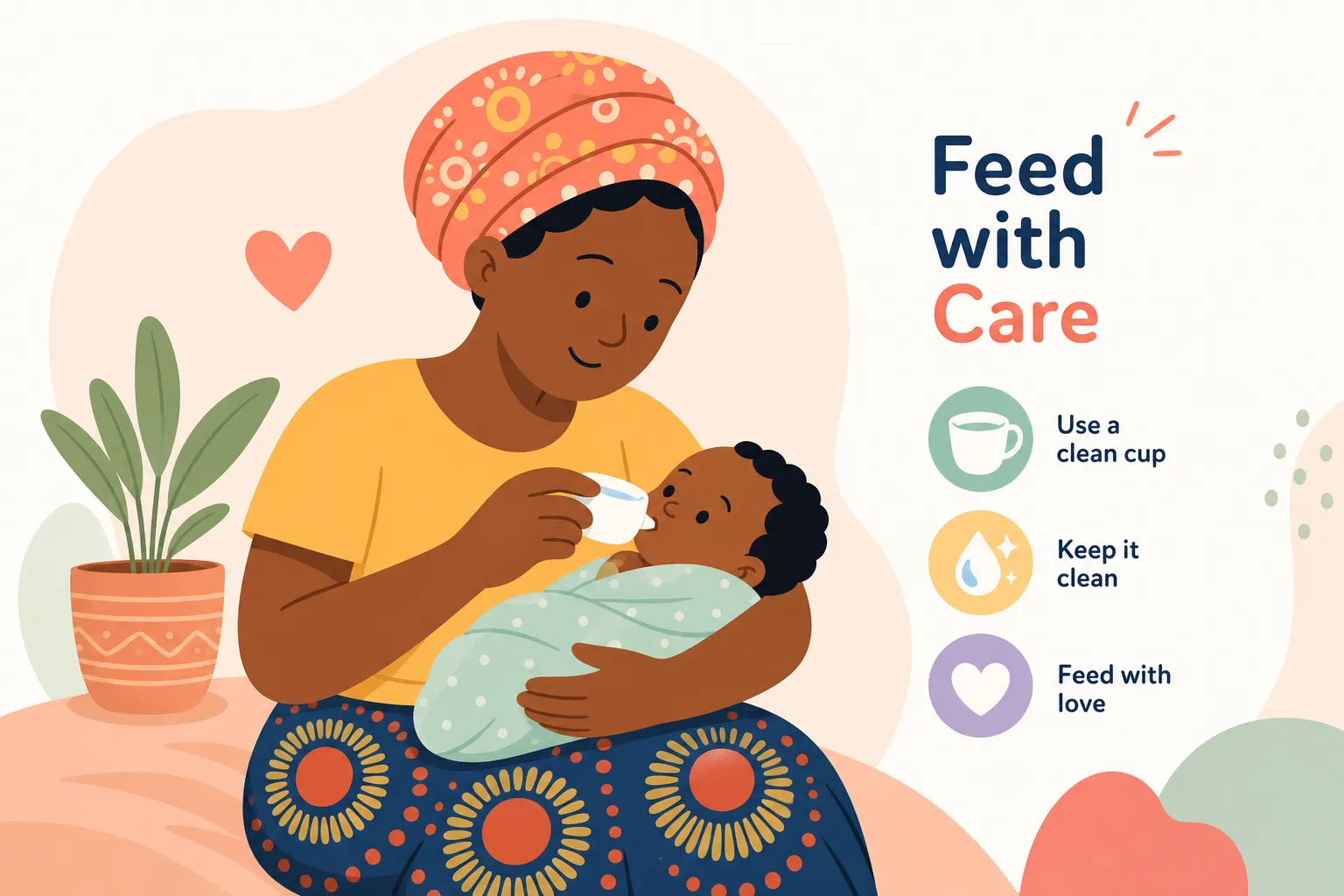
You are sitting with a tiny baby in your arms, skin still new, and the baby will not latch. Or perhaps your newborn has just come home from the NICU, and a nurse handed you a small cup with a quiet word: “Try this.” The anxiety in that moment is real. Your baby needs to eat, and you are not sure what to do next.
Cup feeding for newborns in Kenya is a World Health Organisation-supported, clinically accepted method for babies who cannot breastfeed directly. Many caregivers may not receive a proper practical demonstration of the technique, even though the need is common. Done correctly, it is safe and gentle, and it protects the breastfeeding journey by avoiding nipple confusion from bottle teats. Done incorrectly, it carries real risks. This guide walks you through every step, from choosing the right cup, to reading your baby’s cues, to keeping things clean in a typical Kenyan household.
Purpose-built feeding cups are now available locally, so you no longer need to source specialist equipment from abroad. The Nifty Feeding Cup from Mulan Nutrition is one option designed specifically for newborns, and it is stocked in Kenya. By the time you finish reading, you will know exactly when cup feeding newborns in Kenya is appropriate, how to perform it safely, and how to support your breastfeeding journey alongside it.
When cup feeding is the right choice for your newborn in Kenya
Situations where cup feeding newborns is genuinely helpful
Cup feeding is not a permanent feeding method. It is a short-term bridge designed for specific situations where direct breastfeeding is temporarily not possible. The clearest cases are:
- A newborn who cannot latch despite skilled lactation support
- A mother temporarily separated from her baby due to illness or surgery
- A preterm or NICU baby who is clinically stable and beginning to transition to oral feeds
- Any situation where protecting the breastfeeding relationship means avoiding bottle teats altogether
In many Kenyan households, cup feeding also makes practical sense for a different reason: thorough sterilisation of bottle teats requires reliable hot water and fuel, and when those resources are limited, a smooth-edged silicone cup is simply easier to keep clean. WHO guidance on cup feeding recognises it as a viable alternative to bottle feeding for newborns where hygiene infrastructure is variable.
When cup feeding is not appropriate
A sleepy baby should never be cup fed. When a newborn is not fully awake and alert, the coordination between swallowing and breathing is unreliable, and the risk of milk entering the airway is significant. Babies with neurological conditions, very low gestational age below clinical readiness, or a poor gag reflex are also not suitable candidates. Many neonatal protocols place the lower threshold at around 29 to 30 weeks’ gestation, though local protocols can vary, and cup feeding should only begin once the infant is physiologically stable. For local clinical recommendations, consult a recognised neonatal cup-feeding guideline before starting at home.
If you are unsure whether your baby is ready for cup feeding, speak with your paediatrician or maternal health nurse before attempting it at home. This guide supports informed caregivers; it does not replace a clinical assessment.
What to prepare before the first feed
Once you have confirmed that cup feeding is appropriate for your baby, the next step is gathering the right equipment and milk.
Choosing the right cup for a newborn
A standard household cup is unsuitable for a fragile newborn. It is too large, too rigid, and difficult to control safely. What you need is a small-volume cup, ideally around 30 ml capacity, with a soft rim that will not injure the baby’s mouth, no teat or valve that might cause nipple confusion, and a BPA-free design that is easy to disassemble for thorough cleaning. A purpose-built feeding cup for newborns makes a real, practical difference here. For step-by-step use, see How to Use a Nifty Feeding Cup for Your Newborn, Mulan Nutrition.
The Nifty Feeding Cup, available through Mulan Nutrition in Kenya, is a soft silicone cup designed specifically for newborns with breastfeeding difficulties and those transitioning from NICU care. It has a small reservoir at the spout that lets the baby lap milk at their own pace, millimetre markings to help you track intake, and it is boilable and reusable, features confirmed in the product’s specifications. That reusability matters for daily use in Kenyan homes where keeping costs down is a genuine priority.
Preparing the milk before the feed
Expressed breast milk should be at room temperature or gently warmed before a feed. Preferably avoid offering milk that is very cold, as newborns generally feed more comfortably from milk at body temperature; follow your clinical team’s specific advice on this. For supplemental volumes, a common starting guide is 5 to 10 ml per feed on day one, increasing to 10 to 30 ml per feed as the baby’s intake develops, but your baby’s doctor or feeding team will give you personalised guidance based on weight and gestational age. Keep a clean cloth or muslin bib nearby because some spillage is entirely normal.
The correct cup feeding technique for newborns in Kenya
Positioning your baby for safety
Sit in a comfortable chair with your baby held in a semi-upright position, head and neck aligned, not slumped forward or tilted back. The upright angle is not optional: it keeps the airway in the correct position and reduces the risk of milk flowing toward the lungs. A swaddled baby is easier to hold still, especially in the early days when newborns startle easily. Make sure your own arms are supported so you can hold the position steadily for 15 to 30 minutes.
How to offer the milk: the “lap, don’t pour” principle
Rest the rim of the cup gently on your baby’s lower lip and tip it slowly until milk just touches the lip surface. Your baby will begin to lap or sip from the pool of milk at the rim. This is the correct rhythm. The most common, and most dangerous, mistake is tipping the cup so that milk flows freely into the baby’s mouth. That overrides the natural swallow-breathe sequence and creates an immediate choking risk. For evidence on outcomes and technique, review the available research on cup feeding to understand benefits and risks in different clinical settings.
Keep the principle of “tilt to touch, not to pour” at the front of your mind throughout every feed. The cup stays in contact with the lower lip even during pauses; removing and repositioning it can disturb the baby’s rhythm and increase the chance of spills into an unguarded airway.
Pacing through the feed
After every few sips, pause. Keep the cup resting at the lip rather than pulling it away, and give the baby a moment to swallow and breathe fully before you tip the cup again. A full feed typically takes 15 to 30 minutes, and that timeframe exists for a reason. Rushing is the single biggest mistake caregivers make after the pouring error. A well-paced feed looks calm. The baby sips, pauses, breathes visibly, and sips again, with no signs of strain, and your job throughout is to follow that rhythm rather than drive it.
Reading your baby’s cues throughout the feed
Signs the feed is going well
A baby who is ready to feed is awake, alert, and making small rooting movements or bringing the tongue forward. During the feed itself, look for rhythmic lapping or sipping, quiet and regular breathing between sips, and a relaxed body with unclenched fists. These cues tell you the pace is right and the baby is coping comfortably with what is being offered.
When to slow down or take a break
Rapid breathing, a pause in the sipping, or milk running steadily down the chin are all signals to pull back gently and let the baby settle. A baby who turns the head away or closes the mouth is communicating clearly: the feed needs to slow or stop. Pacing is your responsibility throughout; how much the baby takes is the baby’s decision. Do not chase the feed or encourage the baby to take more once these signals appear.
Stopping the feed and when to call a doctor
If your baby coughs, sputters significantly, or shows any colour change around the mouth, particularly if the lips or skin look pale or bluish, stop the feed immediately. Hold the baby upright, tipped slightly forward, and gently stroke or pat the back. Most brief coughing episodes resolve within a few seconds. If the baby does not recover quickly, breathing remains laboured, or colour does not return to normal, this is a medical emergency: call for help without delay. Read more about aspiration in babies and children to recognise danger signs and first-aid steps.
Outside of emergency moments, flag these patterns to a paediatrician: your baby consistently refuses feeds, vomits repeatedly between feeds, or is not gaining weight as expected. Ongoing poor intake is a clinical matter, not something to manage alone at home.
Cleaning and sterilising your feeding cup safely in Kenya
Washing after every single feed
Leftover breastmilk is a growth medium for bacteria, and in Kenya’s warm climate that growth happens quickly. Wash the cup immediately after each feed with hot water and soap, using a dedicated brush that reaches all interior surfaces. If the cup has separate parts, such as the Nifty Feeding Cup’s reservoir and body, disassemble fully and clean each piece individually. Rinsing alone is not enough; soap needs to work on every surface before any sterilisation step.
Sterilising your cup feeding equipment in Kenya: boiling vs the bleach method
Boiling is the most accessible sterilisation method for most Kenyan households. Place all disassembled parts in a pot, fully submerged with no air bubbles trapped inside, bring to a rolling boil, and maintain for five minutes. Remove with clean tongs and place on a clean surface to air-dry. Do not touch the inner surfaces with your hands or a cloth.
For households where fuel or water is limited, a bleach solution is a fully accepted alternative. Mix two teaspoons of unscented household bleach into 16 cups of water in a clean basin. Submerge all cup parts and soak for at least two minutes. Remove with clean tongs and do not rinse afterwards; rinsing reintroduces germs. Before using either method, check that your cup material is safe for it. The silicone Nifty Feeding Cup is stated by the manufacturer to be compatible with both boiling and chemical sterilisation, confirm this against the product documentation supplied with your cup.
Drying and storing the cup between feeds
Air-dry all parts on a clean, unused cloth or a dedicated drying rack. A damp cup stored before it is fully dry will grow bacteria regardless of how well it was sterilised. Once dry, store the cup in a covered container or a closed cupboard used only for clean feeding equipment. Keep it away from the sink, open counters, and anywhere that dust, flies, or splashing water can reach it.
Supporting breastfeeding while cup feeding
Cup feeding as a bridge, not a destination
Every cup feed is most effective when it sits alongside active efforts to resolve the underlying breastfeeding challenge, whether that is working on latch, building milk supply, or recovering from a difficult birth. Offer the breast at each feed before reaching for the cup, and maintain skin-to-skin contact as much as possible. These are not competing approaches; they work together. The cup is there to keep your baby nourished while you and your baby work through the breastfeeding journey. For guidance on continuing breastfeeding goals, see How to Exclusively Breastfeed for 6 Months in Kenya, Mulan Nutrition.
Practical tips for cup feeding newborns in Kenya
Formal lactation consultant services are not widely available across Kenya, but community health workers and maternal health nurses at local clinics can offer meaningful support. Ask your nearest clinic about feeding support at your postnatal visits. If you are using cup feeding at home, practise the technique with a health worker present at least once before doing it alone; the first feed is always easier with a second set of eyes.
Getting the technique right and having appropriate equipment genuinely makes a difference. The Nifty Feeding Cup is available through Mulan Nutrition in Kenya for families who need a purpose-built tool, without the cost and delay of importing specialist equipment. Where to Buy Nifty Feeding Cups in Nairobi, Mulan Nutrition has local purchase and contact details if you need guidance on which option suits your baby’s specific needs.
Your next step: cup feeding your newborn in Kenya with confidence
Cup feeding newborns in Kenya is a safe, WHO-supported method that any caregiver can learn with the right guidance. Position your baby upright, pace the feed so the baby leads, and keep the cup thoroughly clean after every use. Hold to those principles and you give your baby a safe and nourishing feed each time.
Bookmark this guide and return to it as often as you need. If possible, run through the technique once with a health worker before your first solo attempt at home. When you are ready to choose a feeding cup, the Nifty Feeding Cup from Mulan Nutrition is a soft, reusable, easy-to-sterilise option designed for exactly this situation, and it is available locally, so you can get started without delay.
Related Posts
 How a supplemental nursing system works for low supply
 Where to Buy Nifty Feeding Cups in Nairobi